How to Learn Korean From K-Dramas: A Beginner’s Method
If you love K-dramas, you’ve probably already heard the same Korean words and phrases again and again. Maybe you can recognize 괜찮아 (gwaenchana) even before the subtitles appear, or you’ve wondered why a character suddenly switches from polite Korean to casual speech.
That’s where K-dramas can become a surprisingly useful way to learn Korean. Instead of trying to memorize everything at once, start with the words, phrases, and speech patterns you naturally hear while watching.
This guide gives you a simple path through our beginner Korean articles, so you can build your understanding step by step.
A simple method you can use while watching
You don’t need to pause every few seconds or turn your favorite drama into a classroom. Try this simple four-step approach instead:
- Watch: enjoy the scene normally, with subtitles if you need them.
- Notice: pay attention when you hear a Korean word or phrase you recognize.
- Look it up: check what it means and how it is being used in that particular situation.
- Listen again: notice the pronunciation, tone, and speech style when you hear the expression again.
Don’t try to learn everything at once
One of the advantages of learning Korean through K-dramas is that the language comes with a story. You can see who is speaking, who they are speaking to, and what is happening around them.
That context can help you understand things that a dictionary definition cannot show on its own.
Start with one phrase. Recognize it in another episode. Learn another one. Then start noticing how the characters speak differently to different people.
Your Korean-from-K-dramas learning path
-
5 Korean Phrases From K-Dramas Every Beginner Should Know
Five everyday phrases you hear in almost every K-drama, with Hangul, meaning, tone, and casual versions.
-
Gwaenchana (괜찮아) Meaning: How to Say “It’s Okay” in Korean
One word, five moods: how tone turns 괜찮아 (gwaenchana) into comfort, a brush-off, or hidden hurt
-
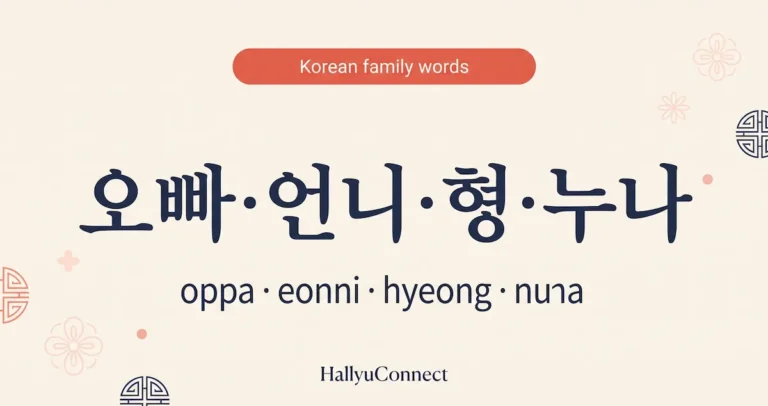
Oppa, Unnie, Noona, Hyung: Korean Family Words in K-Dramas
Who says which word, and how it shifts from a sweet request to romance to jealousy in K-dramas.
-
Polite vs Casual Korean: Why K-Drama Characters Switch Styles
Same sentence, three levels: how switching between casual and polite Korean signals closeness, distance, or a fight in K-dramas.
-
How to Learn Korean From K-Dramas: A Beginner’s Method
A simple, practical method for learning Korean from K-Dramas—what to watch for, what to look up, and how to turn scenes into useful Korean.
-
Hwaiting (화이팅): Why K-Drama Characters Shout “Fighting!
Hwaiting (화이팅): Why K-Drama Characters Shout “Fighting!” If you’ve watched more than a few K-dramas, you’ve probably heard someone shout something that sounds exactly like…
-
Aigo (아이고): The One Word Korean Grandmas Use for Everything
One sound, five feelings: how Korean’s all-purpose exclamation shifts from pain to pity to delight depending on how it’s said.
-
네, 아니요 (Ne, Aniyo): Yes and No in Korean — and the Trap That Catches Everyone
Why “no, I’m going” and “yes, I’m not going” are both correct in Korean — the logic behind 네 and 아니요, explained simply.
-
Why Korean Apologies Come With a Bow — and How Deep You Bend Changes the Words
A head nod, a shoulder bow, or the full 90 degrees — how bowing depth and apology words move together in K-dramas.
-
Jebal (제발): The One Word That Turns a K-Drama Scene Desperate
One word, four intensities: how 제발 (jebal) turns an ordinary request into desperate pleading in K-dramas.
-
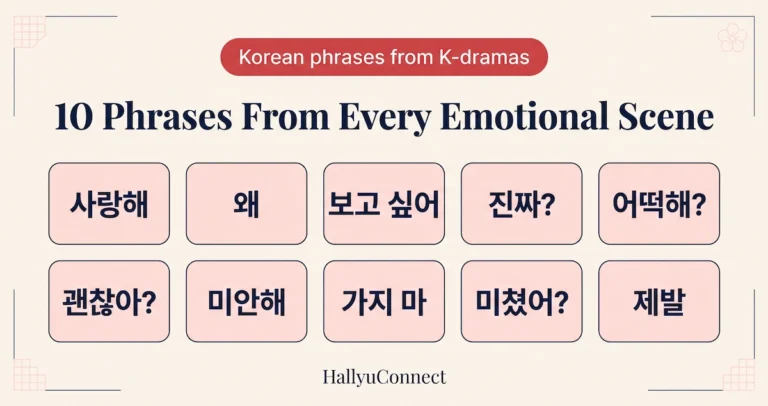
10 Korean Phrases That Show Up in Every Emotional K-Drama Scene
From 사랑해 to 제발, the 10 Korean words that carry every emotional K-drama scene — confessions, fights, and goodbyes.
-
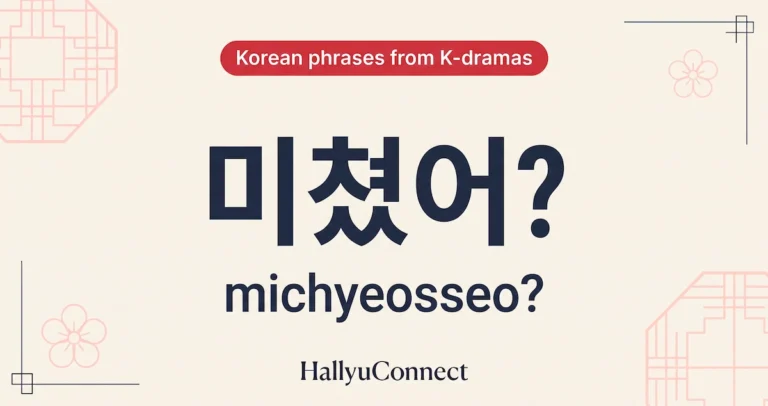
Michyeosseo? (미쳤어?): When “Are You Crazy?” Means You Care
Are you crazy? Four ways K-drama characters use 미쳤어, from real alarm to a quiet confession of feelings that don’t make sense.
-
Daebak (대박): The Korean Slang Word for “No Way, Amazing!
From delighted surprise to flat sarcasm — three moods of 대박, the Korean slang word for “amazing” or “no way.”
-
Joahaeyo vs Saranghaeyo: Why K-Drama Confessions Start With “Like” Before “Love”
Why K-drama couples say “I like you” long before “I love you” — the real emotional weight behind 좋아해요 and 사랑해요.
-
Seolma (설마): The Word K-Dramas Say Right Before Everything Falls Apart
The word K-drama characters say right before a plot twist confirms their worst fear — four moods of 설마, from dread to disbelieving hope.
-
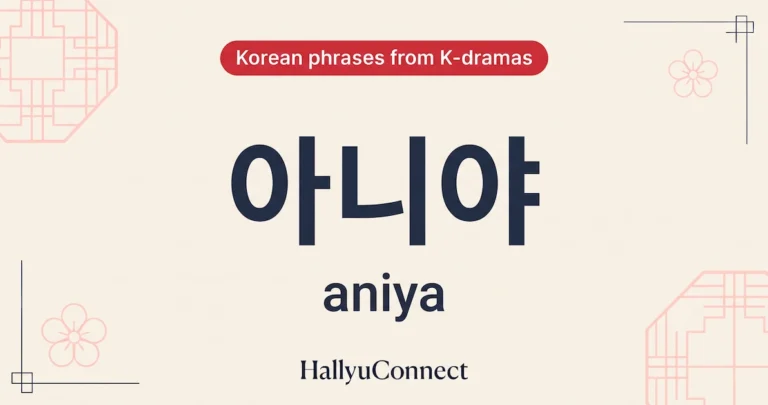
Aniya (아니야): When “No” in K-Dramas Means “You’ve Got It All Wrong”
More than just a casual “no,” 아니야 (aniya) means “that’s not it” or “you’ve got it wrong” — here are the four ways K-drama characters…
-
Sireo (싫어): Why “I Don’t Want To” Is K-Dramas’ Favorite Way to Say No
If you’ve already learned 아니요 (aniyo) and 아니야 (aniya), there’s one more “no” you’ll hear constantly in K-dramas: 싫어 (sireo). Instead of correcting a fact,…
Get the free 30-phrase starter pack
A 10-page PDF of everyday K-drama phrases, with Hangul, pronunciation, casual forms, and a checklist to track your progress.
Your free K-Drama Korean Starter Pack
30 phrases you’ll hear in almost every drama, with Hangul, pronunciation, and when to use them. A printable PDF, free in your inbox.
No spam. Unsubscribe anytime.
We’ll keep adding more guides as the collection grows. Bookmark this page and come back whenever you’re ready to learn your next Korean phrase from a K-drama.
Want to sound like an actual K-drama character? Learn 화이팅 (hwaiting), the cheer you’ll hear in almost every episode.