Why Korean Apologies Come With a Bow — and How Deep You Bend Changes the Words
You’ve seen it in almost every K-drama: someone messes up, and instead of just saying sorry, they bend. A small nod of the head, a stiff bow from the waist, or the full 90-degree bow that practically folds them in half. The bow isn’t just a gesture added on top of the apology — in Korean, how deep you bend and which word you say tend to move together, and both scale with how serious the apology is.
The two apology words
| Word | Register | Typical bow |
|---|---|---|
| 미안 / 미안해 (mian / mianhae) | Very casual to casual | None to a small head nod |
| 미안해 / 미안해요 (mianhae / mianhaeyo) | Casual to everyday polite | Little to no bow — a small head nod at most |
| 죄송해요 (joesonghaeyo) | More polite, more sincere | A short bow from the shoulders |
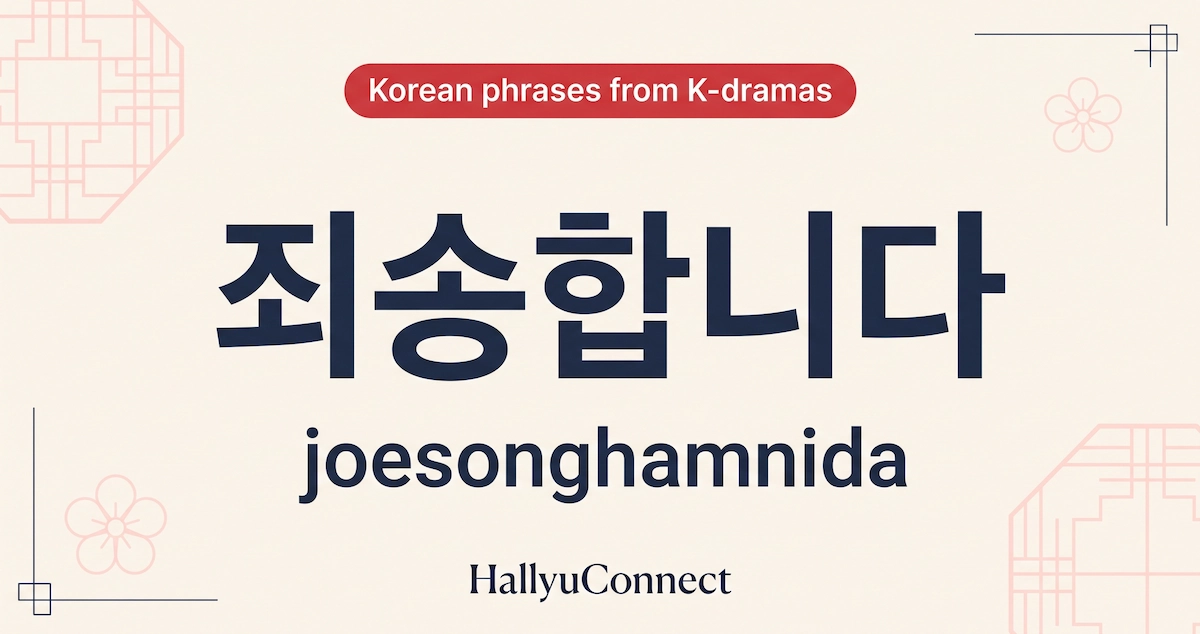
| 죄송합니다 (joesonghamnida) | Formal, serious | A clear bow from the waist |
| 정말 죄송합니다 (jeongmal joesonghamnida) | Very formal, “I’m truly sorry” | A deep, held bow — sometimes the full 90 degrees |
정말 (jeongmal) means “really” or “truly,” and adding it is one of the easiest ways to turn an ordinary apology into an urgent one, in both the words and the body language that goes with them.
미안해 (mianhae) is what you’ll hear constantly between friends and family — fast, casual, often said while already walking away. You’ll also hear the even shorter 미안 (mian), almost just a mumbled “sorry,” and 미안한데 (mianhande), “sorry, but…”, used right before asking someone for a favor.
Four bows, four situations
1. The head-nod 미안
What’s happening: a small, almost reflexive tilt of the head, barely a bow at all.
Where you hear it: bumping into a friend, interrupting someone, small everyday slip-ups between people who are close.
2. The workplace bow
What’s happening: a short, controlled bow from the shoulders, often held for a beat.
Where you hear it: an employee apologizing to a boss, a junior to a senior, or anyone smoothing over a minor professional mistake. 죄송해요 or 죄송합니다 usually goes with it.
3. The desperate full bow
What’s happening: the dramatic 90-degree bow, sometimes held for several seconds, sometimes repeated.
Where you hear it: a character begging forgiveness after a serious betrayal, pleading with someone not to leave, or publicly apologizing for a scandal. Almost always paired with 정말 죄송합니다, sometimes shouted rather than spoken.
4. The sarcastic bow
What’s happening: an exaggerated, stiff bow paired with a flat or annoyed tone, the opposite of sincere.
Where you hear it: a character forced to apologize but clearly doesn’t mean it. The words say 죄송합니다, but the bow is performed just enough to technically count.
Why the bow matters as much as the word
In a culture where politeness is built into the grammar itself, body language fills in what words alone can’t. A deep bow can make a casual 미안해 feel more sincere, and a shallow, quick one can undercut even the most formal 죄송합니다. Watching the bow is often a faster way to read how serious a scene is than listening to the word choice alone.
A note on pronunciation
I’m a K-drama fan learning Korean, not a native speaker. Romanization only approximates Korean sounds, and the bow descriptions here are general patterns I’ve noticed from watching, not strict rules — real bowing customs vary by region, workplace, and generation. If anything here is off, please tell me through the contact page.
New here? Start with our beginner’s guide to learning Korean from K-dramas. Or see how one small word carries five different moods in the guide to 괜찮아.