Joahaeyo vs Saranghaeyo: Why K-Drama Confessions Start With “Like” Before “Love”
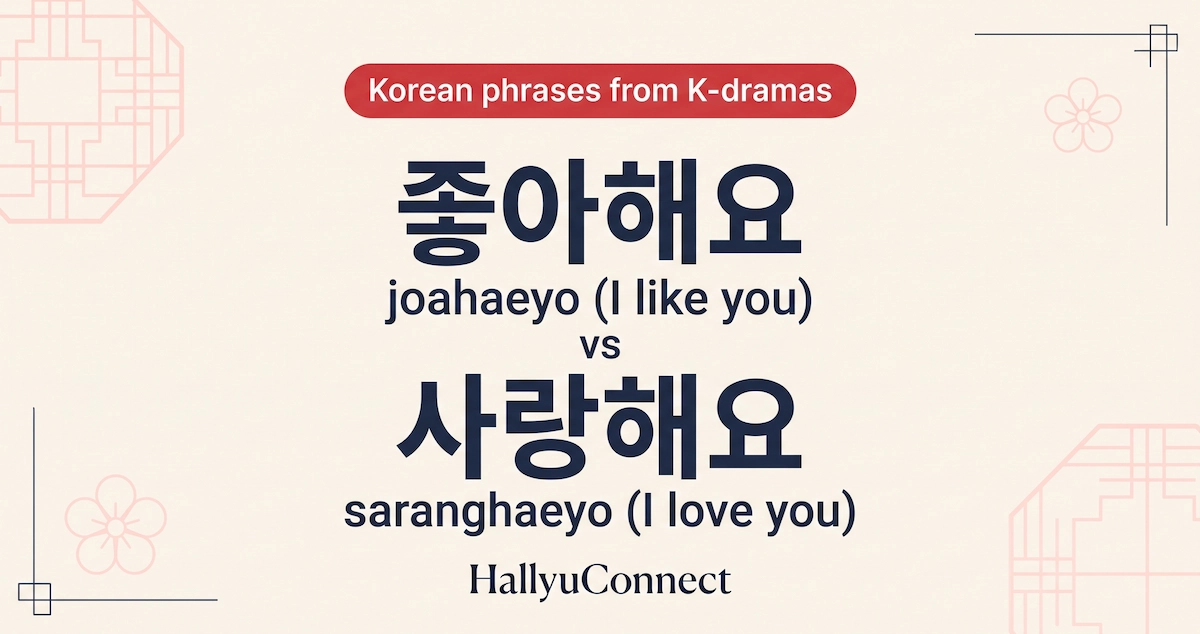
Watch enough K-drama romances and you’ll notice the pattern: the first confession is almost never “I love you.” It’s “I like you” — 좋아해요 (joahaeyo) — said carefully, often nervously, long before anyone reaches for 사랑해요 (saranghaeyo). The gap between those two words isn’t small talk. It’s one of the most reliable emotional beats in the genre.
The two words
| Word | Meaning | Casual form |
|---|---|---|
| 좋아해요 (joahaeyo) | I like you | 좋아해 (joahae) |
| 사랑해요 (saranghaeyo) | I love you | 사랑해 (saranghae) |
좋아하다 (joahada), the root of 좋아해요, is also the everyday word for liking anything — a food, a song, a hobby. Context is what tells you whether someone means “I like this show” or “I like you, romantically.” When it’s said directly to a person, eye contact held, voice a little unsteady, there’s no ambiguity about which one it is.
Why the escalation matters
사랑해요 is a bigger word, and K-dramas treat it that way. Confessing 좋아해요 first is lower-risk — it’s honest, but it still leaves room to back out, to be rejected gently, to keep some distance if the feeling isn’t returned. 사랑해요 doesn’t leave that room. Saying it means the relationship has moved from “I’m interested” to “I’m in this,” and dramas use the jump between the two words to mark exactly when that shift happens.
Three moments to listen for
1. The nervous first confession
What’s happening: one character admits their feelings for the first time, usually with 좋아해요.
How it sounds: hesitant, often rehearsed-sounding, sometimes blurted out all at once.
Where you see it: after weeks of near-misses and almost-moments, finally said out loud, often followed by an agonizing pause before any response.
2. The quiet realization
What’s happening: a character says 사랑해 or 사랑하는 것 같아 (saranghaneun geot gata, “I think I love you”) to themselves, before they’ve said it to the other person.
How it sounds: quiet, almost stunned, often while staring at the other person from a distance.
Where you see it: the moment the audience learns a character’s feelings have deepened, well before the other character finds out.
3. The full confession
What’s happening: 사랑해요 finally gets said directly, usually at a turning point — before a separation, during a crisis, or once every obstacle in the plot has been cleared.
How it sounds: steadier than the first confession, sometimes through tears, often said as if it’s the most obvious thing in the world now.
Where you see it: confessions, proposals, and the emotional high point most romance dramas build toward.
A note on pronunciation
I’m a K-drama fan learning Korean, not a native speaker. Romanization only approximates Korean sounds, so use the Hangul as your main guide and listen for it the next time you watch. If you spot a mistake, please tell me through the contact page.
New here? Start with our beginner’s guide to learning Korean from K-dramas. Or see how one small word carries five different moods in the guide to 괜찮아.