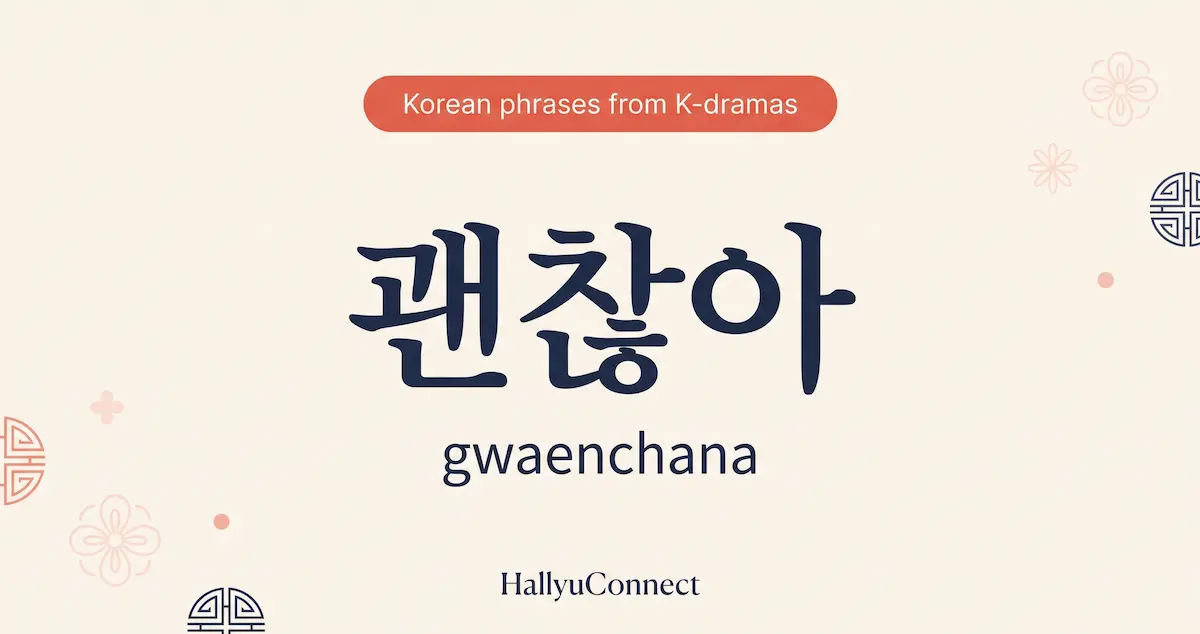
Gwaenchana (괜찮아) Meaning: How to Say “It’s Okay” in Korean
My favourite Korean word is 괜찮아 (gwaenchana). What fascinates me is that the meaning barely changes, yet the tone does all the work. The same word can comfort someone, wave off a small mistake, or hide real hurt, and once you start listening for it in K-dramas, you can hear the difference.
What 괜찮아 means
At its simplest, 괜찮아 means “it’s okay” or “I’m fine.” Depending on the situation, it can also mean “no problem,” “never mind,” or, with a rising tone, “are you okay?” You will see it romanized as gwaenchana (the official system) or gwenchana (a common informal spelling). It sounds like gwaen-cha-na, and the ㅎ in the middle is silent.
The forms to know
- 괜찮아 (gwaenchana): casual, used with close friends, family, and people younger than you
- 괜찮아요 (gwaenchanayo): polite and everyday
- 괜찮습니다 (gwaenchanseumnida): formal
- 괜찮아? (gwaenchana?): casual question, “Are you okay?”
- 괜찮으세요? (gwaenchaneuseyo?): polite question, especially to elders or strangers
Five moods of one word
1. The comforting 괜찮아
Meaning: It’s okay. Don’t worry.
How it sounds: soft, slow, and steady, often repeated: 괜찮아, 괜찮아.
Where you hear it: when someone calms a friend who is upset, scared, or apologizing.
2. The easy-going 괜찮아
Meaning: No worries, it’s nothing.
How it sounds: light and quick, often with a smile.
Where you hear it: after a small mistake, like a spilled drink or arriving a few minutes late.
3. The “I’m fine” that isn’t
Meaning: The words say “I’m okay.” The feeling says the opposite.
How it sounds: quiet, flat, and short, sometimes after a pause.
Where you hear it: when a character is hiding hurt. Viewers can tell from the delivery, not the words. When the words say okay but the voice says otherwise, trust the voice.
4. The worried 괜찮아?
Meaning: Are you okay?
How it sounds: the pitch rises at the end, which turns the statement into a question.
Where you hear it: when someone checks on a friend who is hurt or upset. With elders or strangers, the polite form is 괜찮으세요? (gwaenchaneuseyo?).
5. The polite refusal 괜찮아요
Meaning: No, thank you. I’m fine.
How it sounds: friendly but firm, often with a small smile or a shake of the head.
Where you hear it: when someone offers food, help, or a ride and the other person politely declines. The more formal version is 괜찮습니다 (gwaenchanseumnida).
괜찮아 is the casual form and 괜찮아요 is the polite one. To learn when to use each, and what it means when a character switches between them, read polite vs casual Korean.
A note on pronunciation
I’m a K-drama fan learning Korean, not a native speaker. Romanization only approximates Korean sounds, and descriptions of tone are hard to capture in writing, so use the Hangul as your main guide and listen to a dictionary with audio, such as Naver’s. If you spot a mistake, please tell me through the contact page.
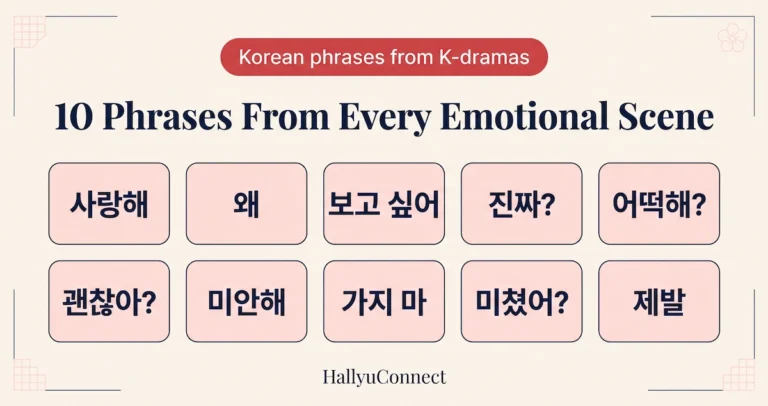
Want more phrases like this one? See 5 Korean phrases from K-dramas every beginner should know.
Another word whose meaning depends entirely on tone: see our guide to 아이고 (aigo).
Want more phrases like these? Get the free 30-phrase starter pack, a printable PDF with Hangul, pronunciation, and a checklist.