Oppa, Unnie, Noona, Hyung: Korean Family Words in K-Dramas
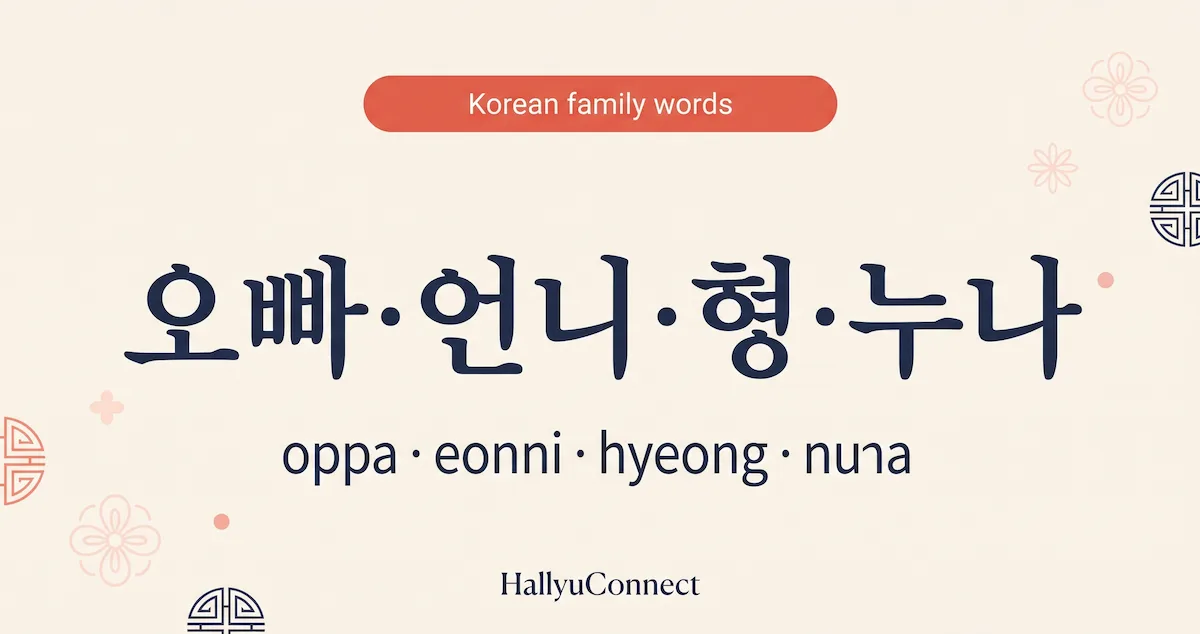
If you watch K-dramas, you have heard characters call each other oppa, unnie, noona, and hyung, often people who are not related at all. These are older-sibling titles, and Koreans also use them for close friends, partners, and friendly seniors. Which word you use depends on two things: your own gender and the gender of the older person you are talking to.
The quick guide
| If you are… | Calling an older man | Calling an older woman |
|---|---|---|
| A woman | 오빠 (oppa) | 언니 (eonni, unnie) |
| A man | 형 (hyeong, hyung) | 누나 (nuna, noona) |
You will see several English spellings for each word. The first spelling in brackets is the official romanization (Revised Romanization), and the second is the one fans commonly use.
Four words, four situations
오빠 · oppa
Meaning: older brother, or an older man you are close to
Who says it: a woman or girl
Where you hear it: between siblings, close friends, and couples. Between a couple it often sounds affectionate, and it can be playful or teasing.
How it sounds: o-ppa (the pp is tense, a firm p without a puff of air)
언니 · eonni (unnie)
Meaning: older sister, or an older woman you are close to
Who says it: a woman or girl
Where you hear it: between sisters, close friends, and coworkers who have become close, or when a younger woman looks up to an older one.
How it sounds: eon-ni
형 · hyeong (hyung)
Meaning: older brother, or an older man you are close to
Who says it: a man or boy
Where you hear it: between brothers, in friend groups, on sports teams, and in mentor-like friendships between a younger and an older man.
How it sounds: hyeong (commonly written “hyung”)
누나 · nuna (noona)
Meaning: older sister, or an older woman you are close to
Who says it: a man or boy
Where you hear it: between a brother and his older sister, and from a younger man to an older woman he is fond of. In romance storylines it can be tender or teasing.
How it sounds: nu-na
What does oppa mean in a relationship?
The word itself stays the same, but the mood around it changes a lot. Viewers learn to hear the difference: the same “oppa” can be a favor request, a love confession, or a warning sign. These are patterns you notice in dramas, not strict rules, and real relationships vary.
1. The sweet request (siblings)
What’s happening: a younger sister softens up her older brother before asking for something.
How it sounds: 오빠~ in a drawn-out, sing-song voice, often followed by a favor: 부탁 하나만 들어줘 (butak hanaman deureojwo, “do me just one favor”).
Where you hear it: when she wants pocket money, food, a ride, or help keeping a small secret. It is a mild form of 애교 (aegyo), the affectionate, cute behavior people use to persuade someone close to them. A younger brother can play the same trick on his older sister with 누나.
2. The romantic shift (couples)
What’s happening: a woman who used to call a man by his name, or by a formal title, starts calling him oppa. It tells the audience the relationship has moved from distance to closeness.
How it sounds: softer and warmer, often at the start or end of a sentence: 오빠, 보고 싶어 (oppa, bogo sipeo, “oppa, I miss you”).
Where you hear it: the first time a couple crosses from polite to affectionate, and in everyday sweet moments once they are together. Writers often use that first “oppa” as a small romantic turning point.
3. The jealousy trigger
What’s happening: another woman calls the man oppa in a sweet voice. The word that feels tender between partners feels like a threat when someone else says it.
How it sounds: cheerful and familiar from the other woman, followed by a pause, a side glance, or a sharp change of mood from the partner.
Where you hear it: love triangles, or when a childhood friend, a junior at work, or a fan appears and speaks to the male lead with unexpected closeness. It is a common drama trope, and now you know what the silence afterward means.
4. The dropped title
What’s happening: a woman who always says oppa suddenly uses the man’s plain name instead. Or the reverse: a character who was distant starts adding the title.
How it sounds: flat, sharp, or sometimes teasing, depending on the scene.
Where you hear it: arguments, break-ups, or playful moments when someone wants to tease or claim equality. When the title disappears, it often means the mood has changed. It is not a fixed rule, so listen to the tone, not just the word.
What about younger people?
The word for a younger sibling, or a younger person you are close to, is 동생 (dongsaeng). Anyone can use it, whatever their gender. Older people often just use the younger person’s name instead.
Common mistakes to avoid
- Using them with strangers. These words are for people you are close to. With someone you barely know, they can sound overly familiar or flirtatious.
- Forgetting age. The titles only work for someone older than you. Age matters as much as gender.
- Dropping the name. In real conversation people often add the name first, such as 민수 오빠 (Minsu oppa).
- Using them at work. In formal or workplace settings, people commonly use job titles instead.
These titles show how close two people are, and so does the speech style they use. To hear the difference in dramas, read polite vs casual Korean.
A note on pronunciation
I’m a K-drama fan learning Korean, not a native speaker. Romanization only approximates Korean sounds, so use the Hangul as your main guide and listen to a dictionary with audio, such as Naver’s. These titles also vary a little with age, region, and the closeness of the relationship. If you spot a mistake, please tell me through the contact page.
Keep going: read how one word, 괜찮아, changes with tone, or start with 5 Korean phrases from K-dramas every beginner should know.
Want more phrases like these? Get the free 30-phrase starter pack, a printable PDF with Hangul, pronunciation, and a checklist.