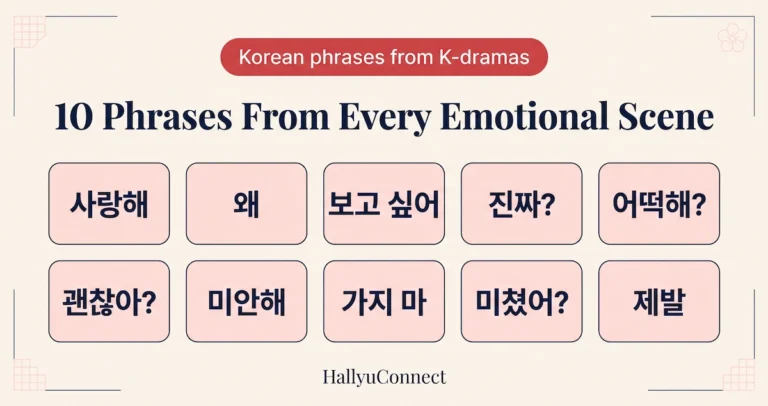
Jebal (제발): The One Word That Turns a K-Drama Scene Desperate
Some words carry a scene all by themselves. 제발 (jebal) is one of them. The moment a character says it, you know things have gone past ordinary asking — this is the word for begging, pleading, and the kind of desperation that doesn’t have time for politeness.
What 제발 means
제발 (jebal) means “please,” but not the everyday please you’d use ordering coffee. It’s closer to “please, I’m begging you” or “for the love of god, please” — an intensifier that turns any request into something urgent. It sounds like jeh-bal, with a clipped, hard stop on the final syllable. Like 괜찮아, it doesn’t change between polite and casual speech; the word itself stays the same no matter who you’re saying it to, which makes it one of the few phrases on this site with nothing to conjugate.
Four moods of one plea
1. The tearful 제발
Meaning: Please, I’m begging you.
How it sounds: quiet, broken, often repeated two or three times through tears: 제발, 제발.
Where you hear it: begging someone not to leave, pleading for a loved one’s life, asking someone to believe them when no one else will.
2. The shouted 제발
Meaning: Please, stop! Just please!
How it sounds: loud, sharp, almost a yell, with the stress hitting hard on the final syllable.
Where you hear it: a character screaming across a room to stop a fight, running after a car that’s pulling away, shouting at someone not to do something dangerous.
3. The exasperated 제발
Meaning: Oh, come on. Seriously, please.
How it sounds: flat, clipped, said through gritted teeth or a heavy sigh.
Where you hear it: a friend reacting to someone’s bad decision, a parent at the end of their patience, someone asking a coworker to just, please, do their job correctly.
4. The soft, hopeful 제발
Meaning: Please, please let this work out.
How it sounds: murmured, almost like a private wish rather than something said to another person.
Where you hear it: a character alone, waiting for test results, hoping a call comes through, silently willing something good to happen. Often said to no one at all.
제발 next to a verb
제발 usually shows up right before the thing someone’s begging for, often paired with a casual command. You’ve actually already seen one of these on this site:
- 제발 가지 마 (jebal gaji ma): “Please don’t go” — one of the most-used lines in K-drama farewell scenes.
- 제발 믿어줘 (jebal mideojwo): “Please believe me.”
- 제발 그만해 (jebal geumanhae): “Please, stop it.”
A note on pronunciation
I’m a K-drama fan learning Korean, not a native speaker. Romanization only approximates Korean sounds, and tone is especially hard to capture in writing, so use the Hangul as your main guide and listen for it the next time you watch. If you spot a mistake, please tell me through the contact page.
New here? Start with our beginner’s guide to learning Korean from K-dramas.