10 Korean Phrases That Show Up in Every Emotional K-Drama Scene
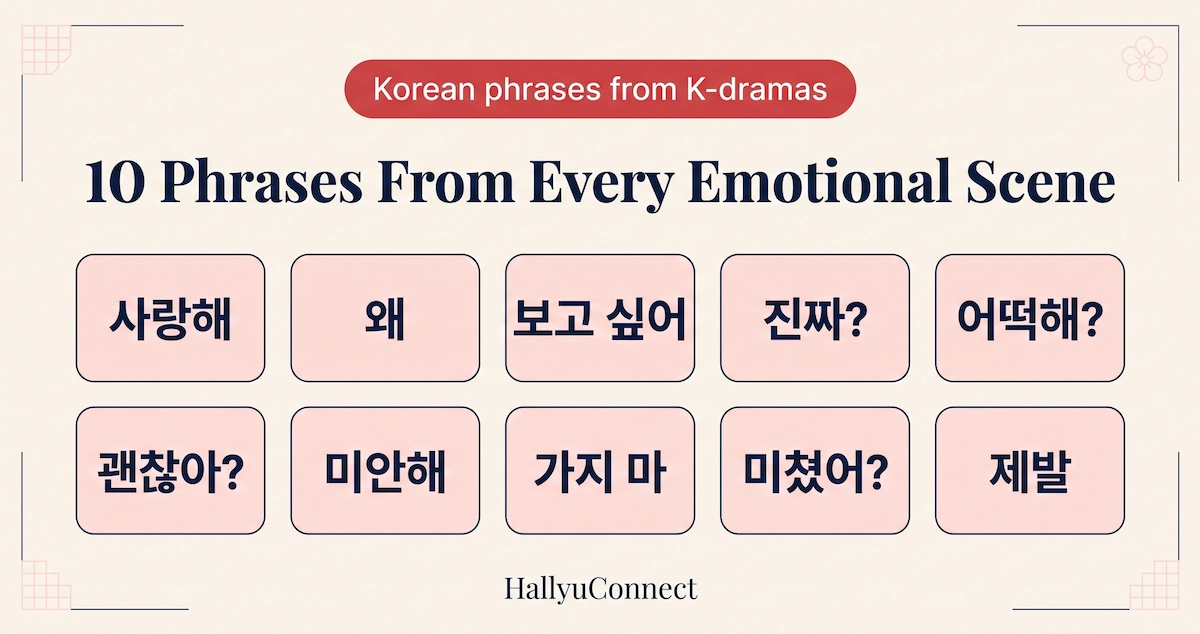
Watch enough K-dramas and a pattern starts to emerge: the big emotional scenes, the confessions, the fights, the airport goodbyes, all tend to lean on the same small set of words. Once you can recognize these ten, you’ll start catching them before the subtitles even load.
1. 사랑해 (saranghae) — I love you
The confession word. Usually said quietly, sometimes shouted across a street. Read the full guide to 5 Korean phrases from K-dramas.
2. 왜 (wae) — Why
One syllable, huge range. Said softly, it’s a gentle “why?” Snapped out sharply, it’s closer to “why would you do that.” Characters use it constantly to question a decision, a confession, or someone standing at their door unannounced.
3. 보고 싶어 (bogo sipeo) — I miss you
Literally “I want to see you.” The phone-call word, the reunion word, the word said into a pillow at 2am. Covered in 5 Korean phrases from K-dramas.
4. 진짜? (jinjja?) — Really? For real?
The reaction word. Said with wide eyes, it’s genuine disbelief. Said flatly, it’s “are you kidding me.” You’ll hear it as a one-word response to almost any piece of surprising news, good or bad.
5. 어떡해 (eotteokhae) — What should I do? Oh no
The panic word. Said when a plan falls apart, when bad news lands, or when a character realizes they’ve made a terrible mistake. Often repeated twice in quick succession: 어떡해, 어떡해.
6. 괜찮아? (gwaenchana?) — Are you okay?
Technically the question form of a word with five different moods. Read the full breakdown in the guide to 괜찮아.
7. 미안해 (mianhae) — I’m sorry
The casual apology, often paired with a small bow. See how bowing depth changes the weight of an apology in why Korean apologies come with a bow.
8. 가지 마 (gaji ma) — Don’t go
Reach for this one in doorways, airports, and rain. It’s the line said right as someone turns to leave, sometimes grabbing a sleeve or a wrist to go with it.
9. 미쳤어? (michyeosseo?) — Are you crazy?
Said as a genuine accusation, it’s alarm. Said between close friends with a laugh, it’s closer to “you’re out of your mind” in a fond way. Read the full range of moods in the guide to 미쳤어.
10. 제발 (jebal) — Please
Not an everyday please — this is the word for begging. Read the full range of moods in the guide to 제발.
Why these ten keep showing up
None of these words are complicated grammar. They’re short, emotional, and built to be said quickly in a moment that doesn’t allow for careful sentences. That’s exactly why they’re useful to learn first: you’ll hear them far more often than textbook vocabulary, and recognizing even one or two in a scene changes how much of it you actually catch.
A note on pronunciation
I’m a K-drama fan learning Korean, not a native speaker. Romanization only approximates Korean sounds, and tone is especially hard to capture in writing, so use the Hangul as your main guide and listen for it the next time you watch. If you spot a mistake, please tell me through the contact page.
New here? Start with our beginner’s guide to learning Korean from K-dramas.