Aigo (아이고): The One Word Korean Grandmas Use for Everything
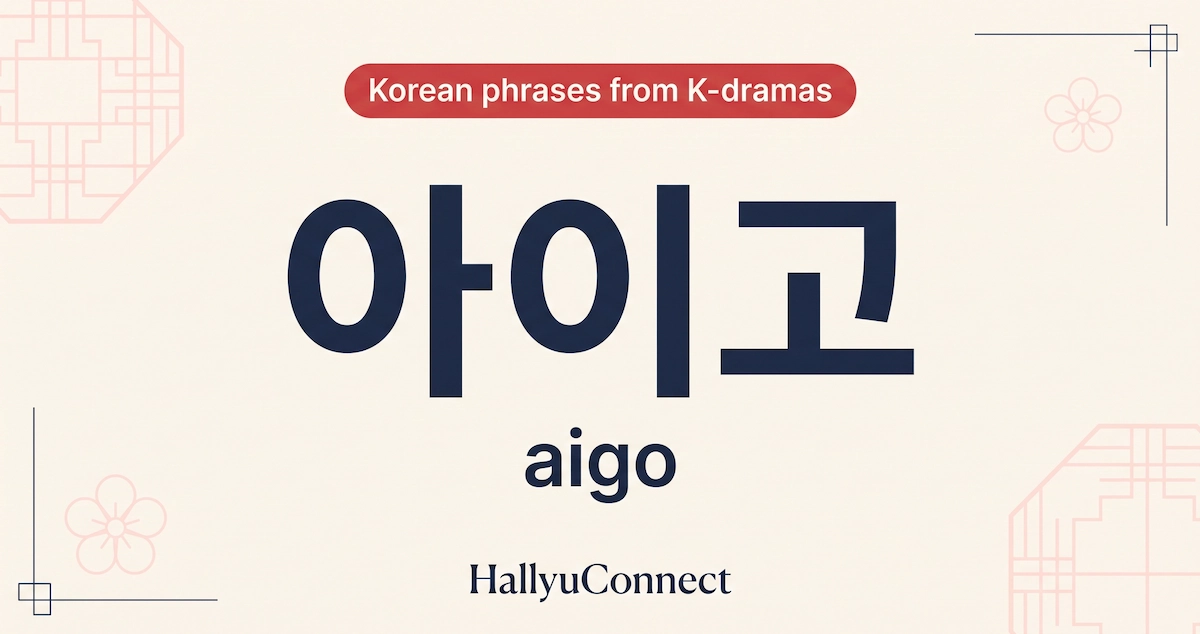
If you’ve watched more than a handful of K-dramas, you’ve heard it: someone drops a dish, stubs a toe, hears bad news, or watches their adult child make a terrible decision, and out comes 아이고 (aigo). It’s one of the most-used words in the entire language, and almost nobody translates it the same way twice, because it doesn’t really mean one thing. It means “my reaction to whatever just happened,” and the reaction changes with the tone.
What 아이고 means
아이고 (aigo) is an exclamation, not a sentence, so there’s no polite or casual form to worry about. Anyone can say it to anyone. It’s commonly romanized as aigo or aigoo, and it sounds like eye-go, with the stress usually falling on the first syllable. You’ll also see the shorter 아이 (ai) and the longer, more dramatic 아이고오 (aigooo) depending on how much feeling someone wants to put into it.
It shows up constantly from older characters especially, so much that it’s almost a verbal signature for an exasperated mother, a tired grandmother, or a long-suffering landlady. But younger characters use it too, just usually with a lighter touch.
Five moods of one sound
1. The small-pain aigo
Meaning: Ouch. Oh no (small version).
How it sounds: short and sharp, often just one syllable before trailing off.
Where you hear it: stubbing a toe, dropping something, sitting down too fast. The everyday, physical version.
2. The exasperated aigo
Meaning: Oh, honestly. Unbelievable.
How it sounds: drawn out, often with a sigh built in: 아이고오.
Where you hear it: a mother watching her grown child do something reckless, a boss reacting to a mistake, anyone dealing with someone who never listens. This is the classic “tired parent” aigo.
3. The sympathetic aigo
Meaning: Oh no, poor thing. That’s rough.
How it sounds: soft, often paired with a gentle hand pat or a sad look.
Where you hear it: comforting a crying friend, reacting to someone else’s bad news, feeling pity for a character’s situation. Often followed by 어떡해 (eotteokhae), “what should I do,” when the sympathy turns into worry.
4. The shocked aigo
Meaning: Oh my! Goodness!
How it sounds: sudden and loud, sometimes with a hand flying to the chest.
Where you hear it: a surprise visitor at the door, unexpected news, catching someone doing something they shouldn’t. The reflexive gasp-word.
5. The warm, welcoming aigo
Meaning: Oh, hello! Look who’s here!
How it sounds: bright and delighted, almost sung.
Where you hear it: a grandmother greeting a grandchild, an old friend arriving unannounced. The happy-surprise version, often paired with reaching out to hug or grab someone’s hands.
How to tell the moods apart
Since the word itself doesn’t change, the clues are all in delivery and context: how long the sound is drawn out, whether it’s loud or soft, and what the character’s face and hands are doing. This is a good word for practicing listening rather than vocabulary, since there’s nothing to conjugate and nothing to memorize beyond the sound itself.
A note on pronunciation
I’m a K-drama fan learning Korean, not a native speaker. Romanization only approximates Korean sounds, and tone is especially hard to capture in writing, so use the Hangul as your main guide and listen for it the next time you watch. If you spot a mistake, please tell me through the contact page.
New here? Start with our beginner’s guide to learning Korean from K-dramas. Or see how tone changes meaning in the guide to 괜찮아.