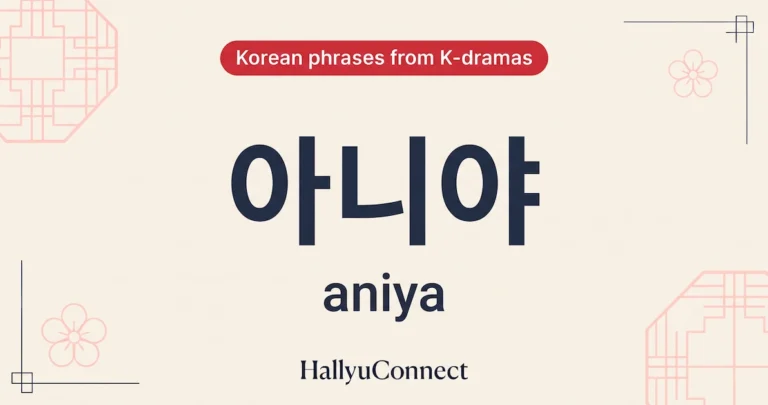
Aniya (아니야) Part 2: 4 More Ways This K-Drama Word Changes Meaning
In our first look at 아니야 (aniya), we broke down why it’s so much more than a casual “no” — from the panicked excuses when someone gets caught smiling at their phone to the gentle comfort of telling a friend not to blame themselves. But if you watch enough K-dramas, you quickly realize four moods weren’t enough to cover this word. Here are four more ways characters use 아니야 to deflect praise, close down a favor, or whisper the truth to themselves.
Four more moods of 아니야
1. The modest deflection (flattery defense)
Meaning: Oh no, not at all! / You’re giving me too much credit.
How it sounds: hurried, polite, paired with both hands waving rapidly back and forth in front of the chest.
Where you hear it: receiving a heavy compliment about looks, intelligence, or hard work. In casual banmal among peers it’s 아니야, 아니야! (aniya, aniya!), while in polite company you’ll hear the -yo ending attached: 아니에요! (anieyo!). Accepting praise outright can feel too boastful in Korean social etiquette, so aniya functions as an automatic cultural shield.
2. The stubborn pride (“I can handle it”)
Meaning: No, it’s fine. / Don’t worry about me.
How it sounds: brisk, firm, slightly strained, refusing to let the other person carry the burden.
Where you hear it: when someone offers to pay the bill, carry a heavy load, or stay up late helping out, and the main character stubbornly insists: 아니야, 내가 할게 (aniya, naega halge) — “No, I’ll do it.” It’s not rejection; it’s a character trying to protect someone else from trouble.
3. The cold cut-off (“Forget it”)
Meaning: Never mind. / Don’t bother.
How it sounds: flat, exhausted, dropping in tone right at the end.
Where you hear it: during or right after an unresolved argument. A character starts to explain their feelings, realizes the other person just isn’t getting it, and pulls back cold with 아니야, 됐어 (aniya, dwaesseo) — “No, forget it.” It sounds quiet, but in K-drama relationship dynamics, it’s a dangerous warning sign that communication has shut down.
4. The internal realization
Meaning: Wait… that’s not right… / It can’t be…
How it sounds: a slow whisper spoken entirely to oneself, eyes widening as puzzle pieces click into place.
Where you hear it: detective scenes, mystery plots, or love triangles. A character reviews a clue or recalls a stray sentence, pauses, and mutters 아니야… right before gasping or turning around. When paired with 설마 (seolma) — as in 설마… 아니지? (seolma… aniji?, “no way… right?”) — you know a major plot revelation is landing in five seconds.
A note on pronunciation
I’m a K-drama fan learning Korean, not a native speaker. Romanization only approximates Korean sounds, and tone is especially hard to capture in writing, so use the Hangul as your main guide and listen to a dictionary with audio, such as Naver’s. If you spot a mistake, please tell me through the contact page.
New here? Start with our beginner’s guide to learning Korean from K-dramas, or revisit our first post on how 아니야 handles misunderstandings and confessions.