Aniya (아니야): When “No” in K-Dramas Means “You’ve Got It All Wrong”
If you’ve already learned that 아니요 (aniyo) means “no” in Korean, you’ve probably noticed characters constantly saying something that sounds almost identical: 아니야 (aniya). At first, it sounds like just the casual version of “no.” In practice, it carries a much more specific job in K-dramas — it’s the sound of someone trying to undo a misunderstanding, hide a crush, or tell someone they aren’t to blame.
What 아니야 aniya means (and how it differs from 아니요)
While 아니요 (aniyo) is a simple “no” used to answer a yes-or-no question, 아니야 (aniya) comes from the verb 아니다 (anida), which means “to not be.” Instead of just saying “no,” 아니야 translates closer to “that’s not it,” “it’s not like that,” or “you’ve got it wrong.”
Because it drops the polite ending, 아니야 is casual speech (banmal) used with close friends, family, or people younger than you — or muttered to yourself. (In polite speech, you’ll hear it as 아니에요, anieyo, or formally as 아닙니다, animnida.)
Four moods of one denial
1. The urgent correction
Meaning: Wait, it’s not what it looks like! / You’ve got it wrong!
How it sounds: rushed, slightly panicked, often repeated twice right as someone turns to walk away.
Where you hear it: the classic K-drama misunderstanding scene. Someone walks in at the worst possible second, jumps to the wrong conclusion, and the speaker blurts out 아니야, 그게 아니라… (aniya, geuge anira…) — “No, it’s not that, it’s…” — usually right before the other person leaves without listening.
2. The flustered crush defense
Meaning: No I don’t! / That’s totally not true!
How it sounds: half an octave too high, overly loud, and completely unconvincing.
Where you hear it: when a friend teases a character about liking someone, or catches them smiling at their phone. The faster and louder the 아니야! comes out, the more obvious it is that the teasing is 100% accurate.
3. The brush-off
Meaning: Never mind. / It’s nothing.
How it sounds: quiet, quick, accompanied by a small wave of the hand or a forced smile.
Where you hear it: a character starts to say something important, loses their nerve, or realizes the other person is busy, and backs out with 아니야, 아무것도 아니야 (aniya, amugeodo aniya), “no, it’s nothing.” It sits right next to the fake 괜찮아 (gwaenchana) in the K-drama hiding-your-feelings toolkit.
4. The gentle comfort
Meaning: Hey, that’s not true. / Don’t blame yourself.
How it sounds: slow, warm, and steady, meant to stop someone from spiraling.
Where you hear it: when a character is blaming themselves for something going wrong, and someone steps in softly with 아니야, 네 잘못 아니야 (aniya, ne jalmot aniya) — “No, it’s not your fault.” Here, the word isn’t defending the speaker; it’s protecting the listener.
How to tell which one you’re hearing
Watch who the speaker is trying to protect. A fast, loud 아니야 is almost always protecting the speaker’s own pride or secret feelings. A quiet, trailing 아니야 is hiding something they aren’t ready to say out loud. And a slow, steady 아니야 is aimed outward, dismantling a harsh thought someone else is having about themselves.
A note on pronunciation
I’m a K-drama fan learning Korean, not a native speaker. Romanization only approximates Korean sounds, and tone is especially hard to capture in writing, so use the Hangul as your main guide and listen to a dictionary with audio, such as Naver’s. If you spot a mistake, please tell me through the contact page.
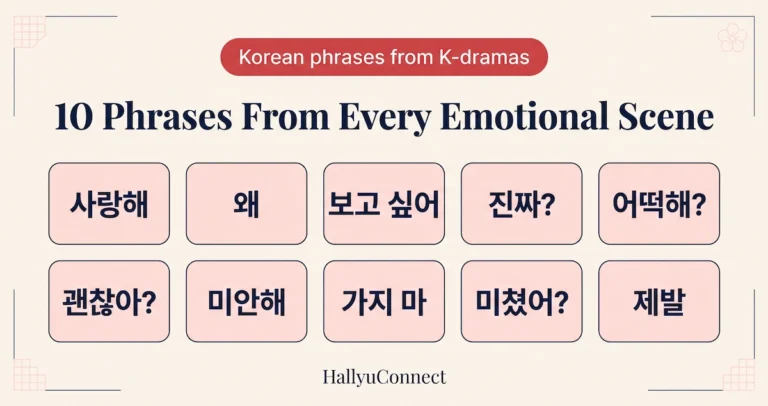
New here? Start with our beginner’s guide to learning Korean from K-dramas. Or see how all ten of the most common dramatic expressions fit together in 10 Korean phrases that show up in every emotional K-drama scene.