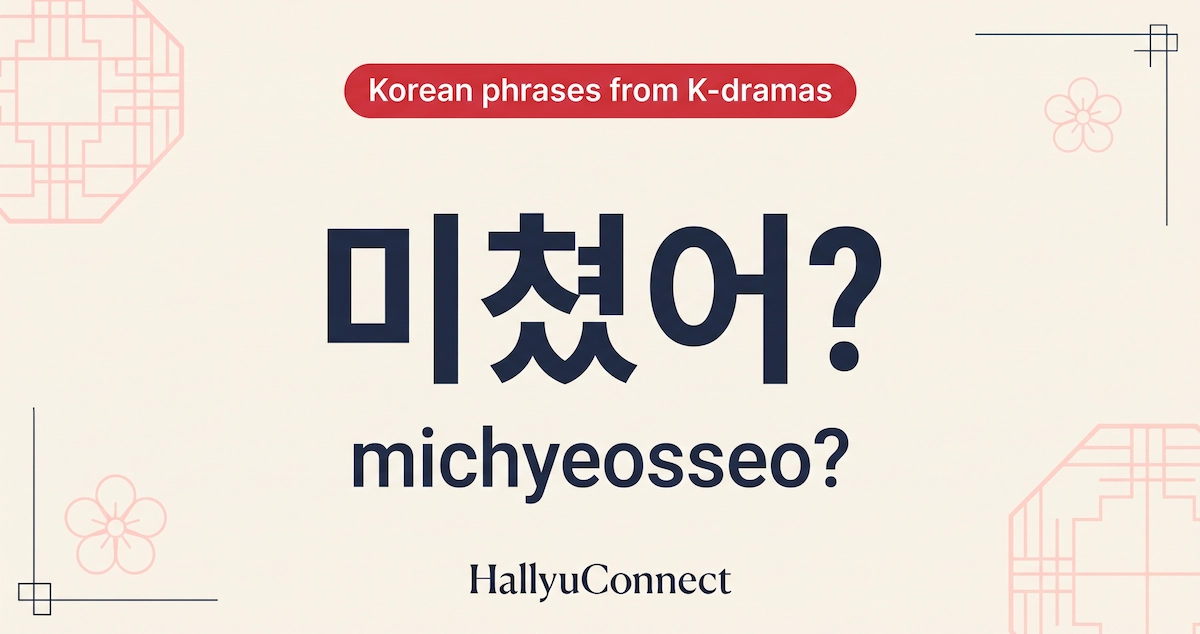
Michyeosseo? (미쳤어?): When “Are You Crazy?” Means You Care
Someone does something reckless, something sweet, or something completely out of character, and another character fires back with 미쳤어? It’s one of the most elastic reactions in Korean — the same two words can be a genuine accusation, a shocked gasp, or, between close friends, almost a compliment.
What 미쳤어 means
미쳤어 (michyeosseo) comes from the verb 미치다 (michida), “to go crazy” or “to go mad,” put into past tense — so it literally asks “did you go crazy?” or states “you’ve gone crazy.” As a question, 미쳤어? means “are you crazy?” As a flat statement, 미쳤어 means “you’re out of your mind.” It’s casual speech, the kind you’d use with friends, siblings, or people younger than you — not something you’d say to a boss or a stranger.
You’ll also hear 미쳤나 봐 (michyeonna bwa), “I think I’ve gone crazy” or “they must be crazy,” used when someone’s describing their own or someone else’s behavior rather than confronting them directly.
Four moods of one accusation
1. The genuine alarm
Meaning: Are you actually crazy? Have you lost your mind?
How it sounds: sharp, loud, often shouted with real panic behind it.
Where you hear it: someone about to do something genuinely dangerous or reckless, like quitting a job on the spot or confronting someone powerful. A real attempt to stop them.
2. The shocked gasp
Meaning: What?! No way!
How it sounds: breathless, high-pitched, often paired with a hand flying to the mouth.
Where you hear it: reacting to unbelievable news, a plot twist, or a confession no one saw coming. Close to 진짜? but with more disbelief packed in.
3. The fond exasperation
Meaning: You’re insane (affectionately).
How it sounds: said with a laugh, often while smiling, sometimes followed by a light shove or a hug.
Where you hear it: between close friends after one of them does something ridiculous but endearing, like showing up uninvited with food, or going out of their way for a favor. This is the version that reads as a compliment, not an insult.
4. The romantic admission
Meaning: I must be crazy (for feeling this way about you).
How it sounds: quiet, almost said to themselves, usually 미쳤나 봐 rather than the sharper 미쳤어?
Where you hear it: a character realizing they’ve fallen for someone they shouldn’t have, or can’t stop thinking about someone despite every reason not to. The self-directed version of the word, closer to disbelief at your own feelings than an accusation.
How to tell which one you’re hearing
Like 괜찮아 and 아이고, this word leans entirely on delivery. A shout means real alarm. A laugh means affection. A whisper, especially paired with 미쳤나 봐, usually means someone’s talking about their own feelings, not someone else’s behavior. Once you can place the four, 미쳤어? stops sounding like one phrase and starts sounding like a small window into exactly how a character feels in that moment.
A note on pronunciation
I’m a K-drama fan learning Korean, not a native speaker. Romanization only approximates Korean sounds, and tone is especially hard to capture in writing, so use the Hangul as your main guide and listen for it the next time you watch. If you spot a mistake, please tell me through the contact page.
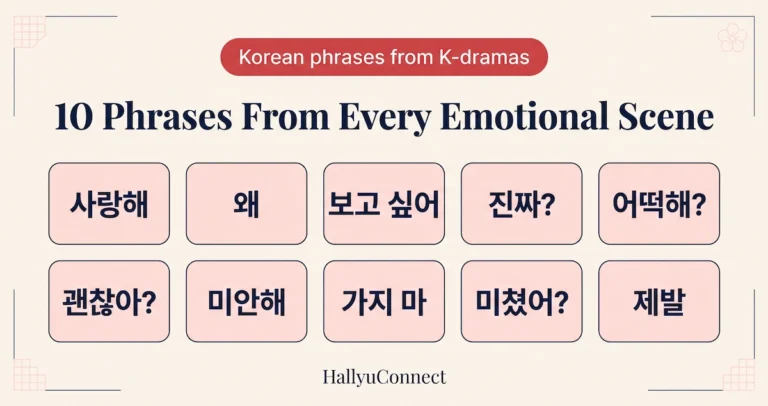
New here? Start with our beginner’s guide to learning Korean from K-dramas. Or see the full set of ten emotional-scene phrases, including this one, in 10 Korean phrases that show up in every emotional K-drama scene.